Clinical Research Platform
client
Estée Lauder Companies
year
'20
timeframe
3 Months
For nearly eight decades, The Estée Lauder Companies has led innovation in global beauty.
Behind every product claim—from wrinkle reduction to hydration performance—lies the work of the Clinical Research team. Their data drives innovation, shapes product strategy, and ensures consumer safety.
But the system powering that data was crumbling.
The Clinical Research Database (CRD), a desktop-based legacy tool, stored critical efficacy data used to substantiate product claims. It was outdated, unstable, and slow. Crashes were frequent. Navigation was unintuitive. Even simple tasks, like locating a panelist, were error-prone.
More critically, users could edit data after submission, putting data integrity and compliance at risk.
With remote workflows accelerating during the pandemic, these cracks became impossible to ignore. What used to be an inconvenience had turned into a liability.
The mission was clear: reimagine CRD as a modern, cloud-based platform that streamlined research workflows, strengthened data governance, and enabled scientists to work with confidence—not workarounds.
Key Outcomes
2× faster task completion on high-frequency workflows
99% accuracy in data handling and reporting post-redesign
100% of users reported improved experience and reliability
New governance framework eliminating post-save edits without admin review
My Role
As Lead UX/UI Designer, I guided strategy and end-to-end design execution—defining how the new system should function, scale, and support long-term R&D goals.
Partnering closely with Business Analysts, Solution Architects, and Developers, I:
Defined UX vision, success metrics, and priorities aligned with R&D leadership
Mapped global workflows and uncovered pain points across research teams
Redesigned data governance rules, introducing locked records + admin-approved edits
Reimagined the product experience using the Cornerstone Design System
Prototyped and usability-tested key flows to validate interactions early
Co-led sprint planning and stakeholder communication in the absence of a PM
Delivered the redesign in 3 months—half the original timeline
Within a strict “lift-and-shift” mandate, I advocated for meaningful UX enhancements and helped evolve Cornerstone with new components that would serve future enterprise applications.
Navigating Uncertainty
At project kickoff, I couldn’t even access the legacy system.
To move forward, I set up daily working sessions with the business analyst and power users, reconstructing the application’s logic through screenshots, recordings, and walkthroughs.
Designing without a working system forced deeper understanding, not just of how the tool functioned, but why it was structured the way it was. That clarity revealed redundancies, hidden dependencies, and opportunities to simplify without compromising compliance.
This became the foundation for a scalable, more intuitive redesign.
Strategy
Despite tight constraints, I identified opportunities where targeted UX improvements could make measurable impact:
1. Role-Based Dashboard
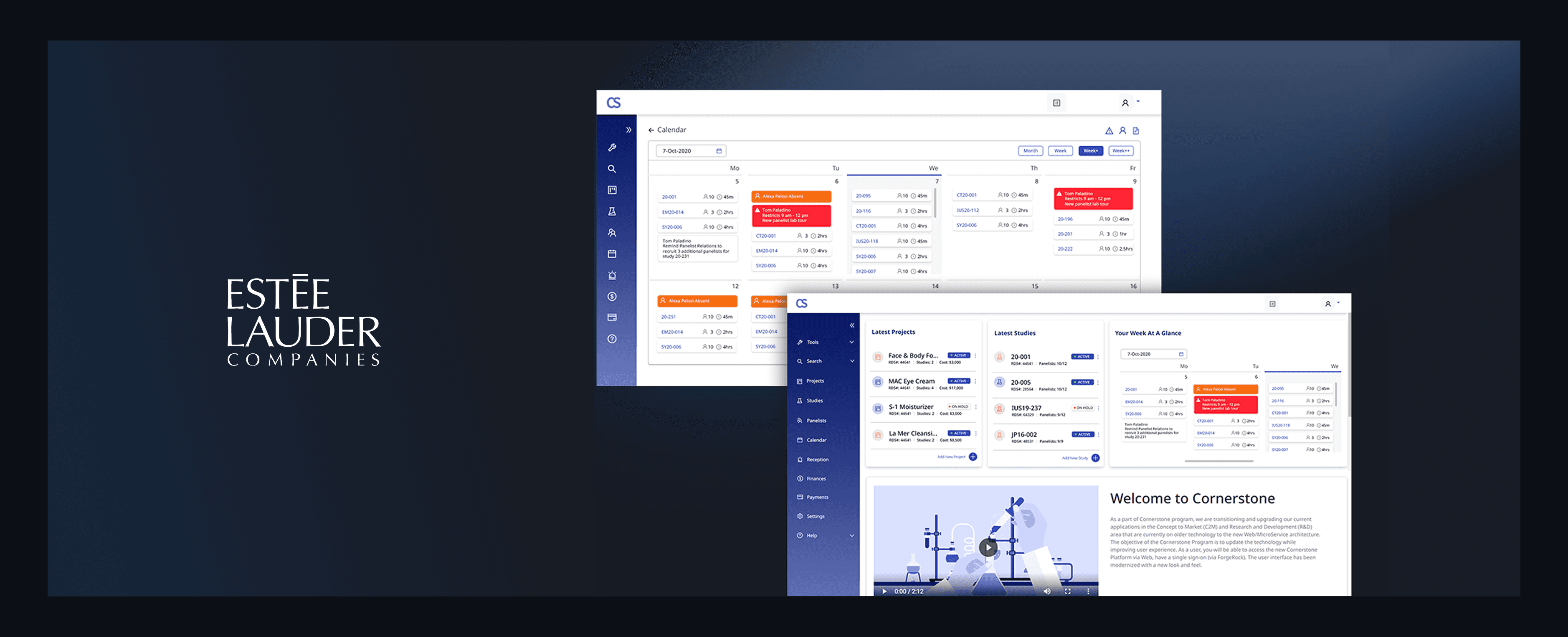
The legacy app opened to a blank screen that provided no value.
I proposed a dynamic role-based dashboard that surfaced upcoming studies, key tasks, and recent activity—transforming unused space into actionable context. Leadership quickly saw the benefit and approved the enhancement.
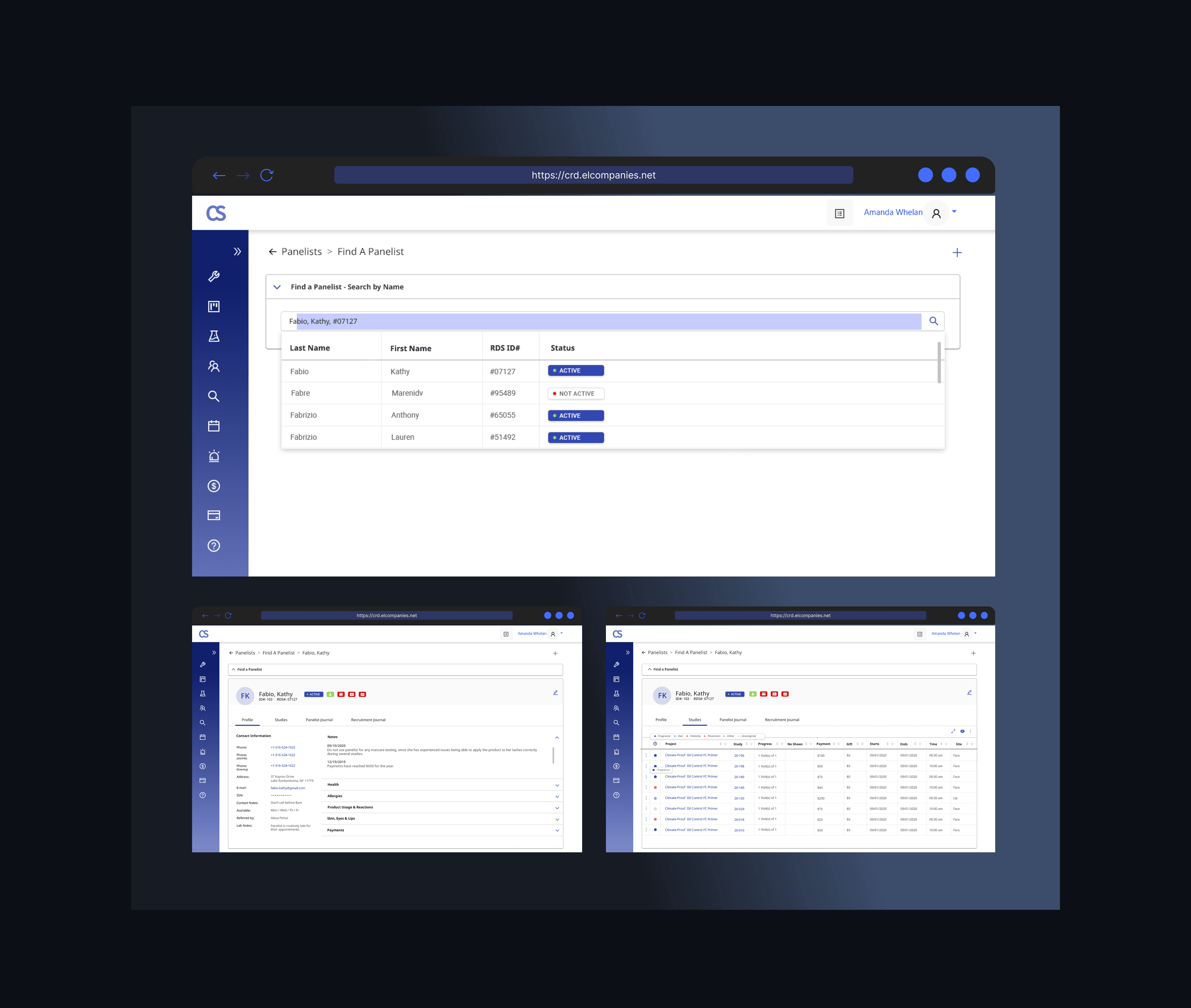
2. Panelist Search Optimization
Panelists are the backbone of ELC’s testing process, yet locating an active participant was slow and inconsistent.
The legacy tool failed to surface availability, despite the data existing in the system.
I partnered with developers to integrate status indicators and an auto-suggest search pattern to instantly show availability.
Result: 50% reduction in task time and far fewer user errors.
3. Data Integrity Framework
The original system allowed users to overwrite records at any time—a major compliance risk.
I redesigned the interaction model so that once data was saved, it locked. Any changes required admin approval, creating a clear audit trail and improving trust in the data.
4. New System Components
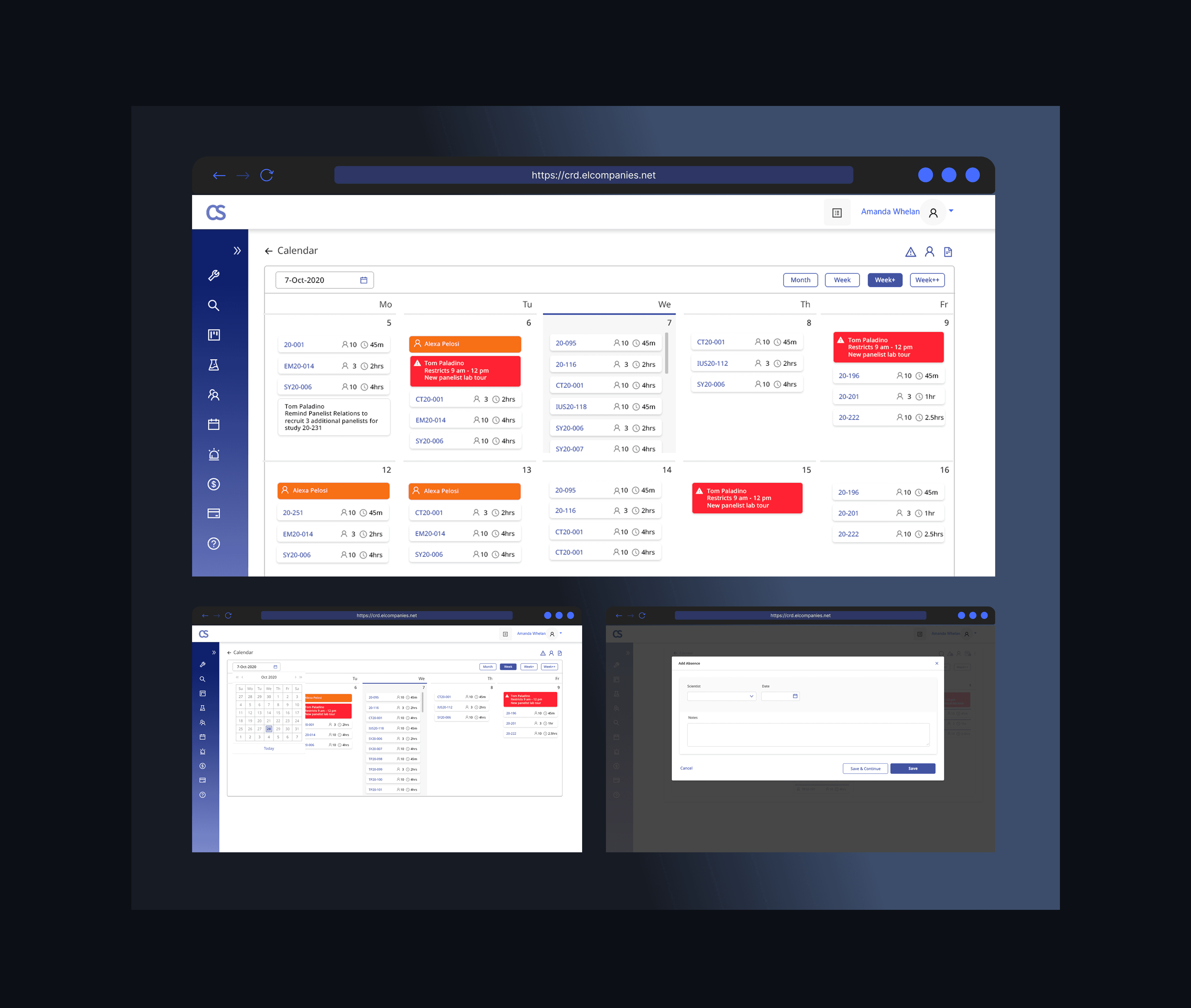
Cornerstone lacked several enterprise components essential for CRD.
I collaborated with Solution Architects to design a reusable calendar module leveraging Ant Design—a component later repurposed across other R&D products.
A project constraint became a long-term design system investment.
Tradeoffs & Scope Constraints
Operating within a strict “lift-and-shift” scope meant prioritizing stability and compliance over larger feature transformations. Several high-value improvements were intentionally deferred:
1. Limited Access to the Legacy System
Early access issues prevented deeper workflow audits.
Tradeoff: Focus on stabilizing core workflows and improving UI patterns rather than restructuring system logic.
2. No PM + Aggressive Timeline
Design and requirements gathering ran simultaneously.
Tradeoff: Advanced features and deeper personalization were documented for future phases to protect delivery.
3. Compliance Limitations
User-requested enhancements like batch editing or inline comparisons introduced regulatory concerns.
Tradeoff: Prioritized the new data governance model first; deferred advanced interactions requiring legal review.
4. Design System Gaps
Cornerstone lacked key components.
Tradeoff: Built only what CRD absolutely needed, deferring visual refinements and broader system updates.
5. Technical Limitations of Legacy Integrations
Existing architecture couldn’t support ideal-state workflows such as real-time sync or flexible role permissions.
Tradeoff: Designed for scalability, implemented only what was safe to ship within constraints.
Impact
The redesigned Clinical Research Database modernized Estée Lauder’s research operations—replacing a fragile, aging tool with a secure, cloud-based platform grounded in UX best practices and strong data governance.
The result was a faster, more intuitive system that preserved scientific integrity and empowered researchers to focus on innovation rather than troubleshooting.
Results:
50% faster task completion across key workflows.
99% data accuracy, meeting new compliance standards.
100% adoption within the first release.
Reflection
This project was a masterclass in navigating ambiguity, driving clarity, and delivering impact under pressure.
With no PM, limited access to the legacy system, and a compressed timeline, I learned to use uncertainty as a design tool—asking sharper questions, aligning faster, and focusing on what delivered real value.
In the end, the success of this redesign wasn’t defined by pixels or components.
It was defined by helping a global organization protect the integrity of its science—and proving that thoughtful design can support both innovation and compliance in harmony.