
Exploring AI-assisted enterprise workflows—where AI can reduce effort, where it should step back, and where human judgment still needs to lead.
Hazard Intelligence is a self-directed extension of the Hazard Reporting platform I originally designed in 2024.
The goal was not to automate the workflow end to end. It was to explore how AI could reduce manual effort in a high-stakes operational experience without creating false confidence or removing human judgment.
Why I Explored It
The original reporting flow required users to choose a hazard type before taking a photo.
That meant classification happened before the strongest piece of evidence was captured, and users could not change the hazard type later. Incorrect selections created downstream work for admins, who had to correct and reroute the report.
I wanted to explore whether reversing that sequence could reduce manual classification and move correction earlier in the workflow.
Revised Workflow
The revised flow adds more system intelligence while reducing upfront decision-making for the user.

Functional Prototype
I turned the revised workflow into a working mobile prototype so I could test the interaction beyond static screens.
The prototype supports photo-first hazard classification, browser camera capture, on-device image recognition, confidence-aware suggestions, and manual correction when the model is uncertain. Users can confirm or change the suggested hazard, verify location, edit report details, and complete a simulated end-to-end submission flow. Safety and emergency guardrails remain in place throughout the experience.
[Launch Live Prototype ↗]
Prototyping The Interaction
I used Codex to move from static screens into a functional prototype and test the complete capture-to-result flow.
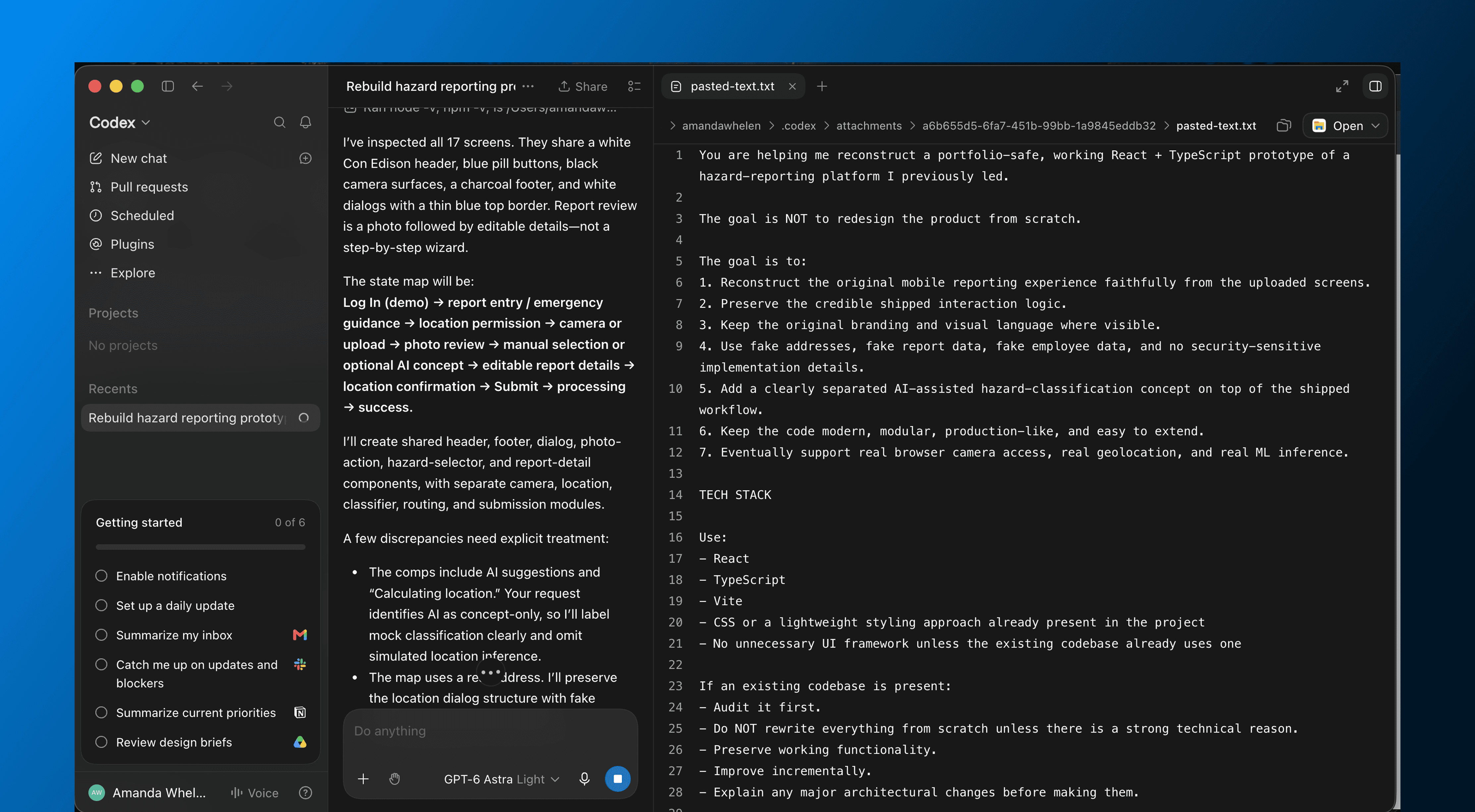
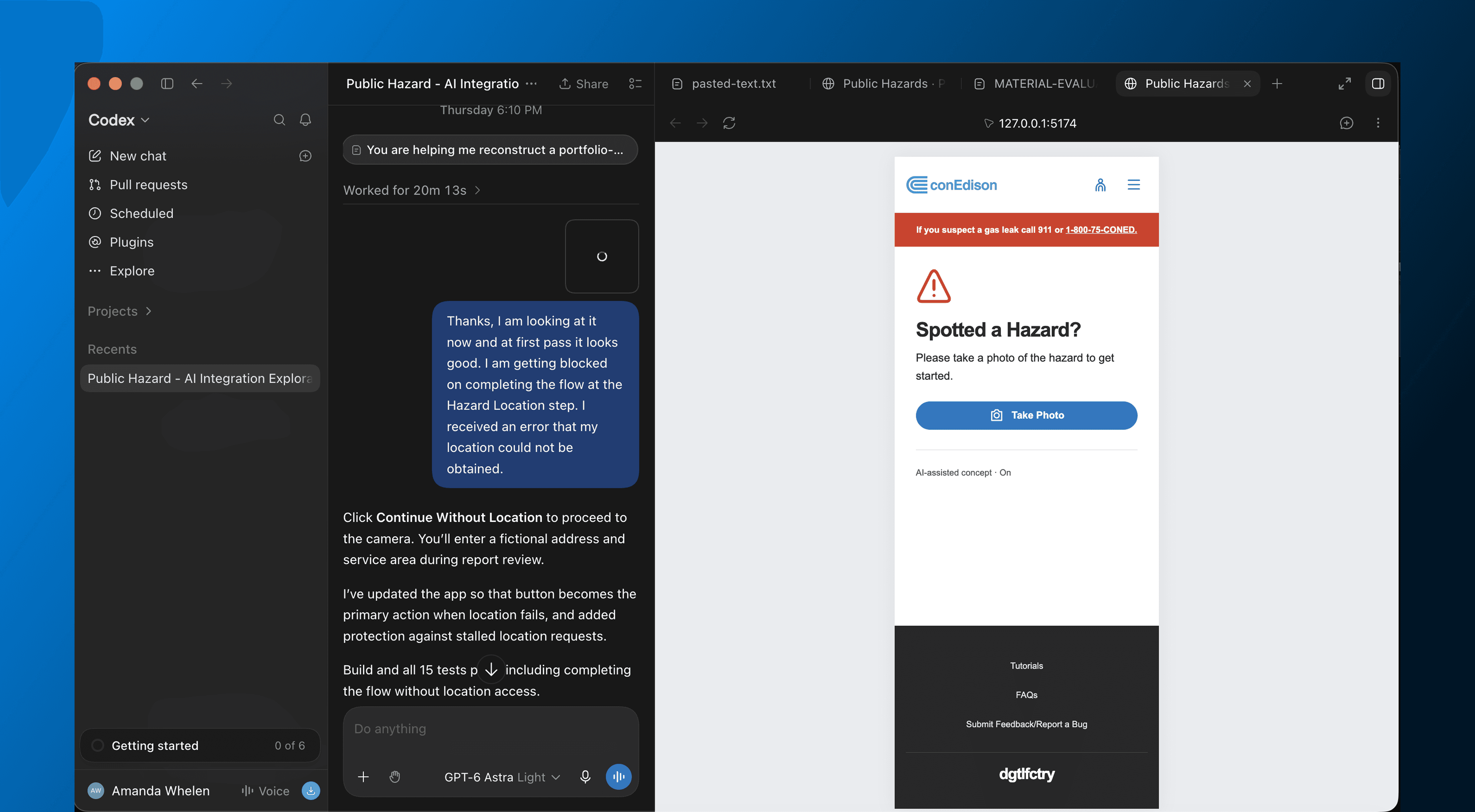
That surfaced issues I would not have caught in Figma alone. During camera testing, for example, the visible preview and the image being sent to the classifier were cropped differently, allowing background content outside the frame to influence the result. I updated the capture behavior so the model analyzed the same image the user saw.
An unexpected model result
I expected a small hazard-specific classifier to outperform the general CLIP model. In limited prototype checks, it didn’t—the trained version returned lower-confidence results more often.
I kept the general model as the prototype default and would bring that finding to engineering for deeper investigation rather than treat it as a final model decision.
Prototype checks only—not a formal accuracy benchmark.
Human Stays In Control
The model can support the decision, but the user still makes it. AI recommends, user decides.
Manual fallback · Editable classification · Required location verification · No automatic submission